




This class allows participants to learn by actually using the tools while understanding their "principles." Our staff participated in the class and will report on the experience.
The theme of the 5th session held on March 14 (Saturday) was "KAMA-ASA Original Western Knife Series amane×Tacos." We used amane knives to cut ingredients and make tacos.
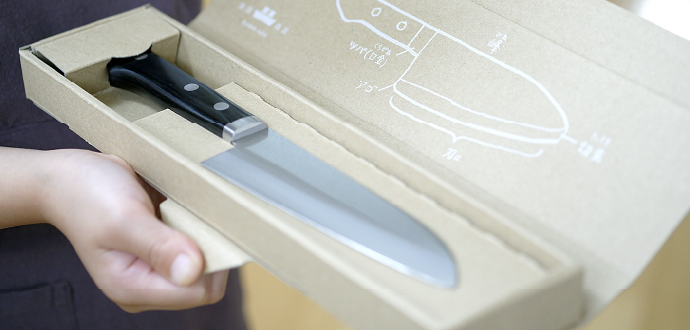
The main tools for this session were the "amane" chef knife and utility knife. While the image of a versatile home knife is often a Santoku or chef knife, even among versatile knives, their cutting techniques differ.
"The Santoku knife is a versatile knife born in Japan. Its shape inherits that of a Nakiri, making it suitable for push and pull cuts due to its straight edge. Since the entire blade contacts the cutting board, it is less likely to make mistakes while cutting. In contrast, the chef knife, which is of Western origin, has a curved blade. By placing the tip of the blade on the cutting board and utilizing the curve to slide while cutting, you can cut easily without applying much force."

Higuchi's recommendation is to use both the chef knife and utility knife.
"I understand the desire to manage with just one knife, but ideally, it's best to use two. Relying on just one will shorten the lifespan of the blade."
In this cooking class, we will use a 21cm chef knife and a 15cm utility knife, which are easy to handle for home use.
Before the cooking lecture, we also experienced the difference in flavor and aroma based on the sharpness of the blade. Comparing tomatoes, bell peppers, and onions cut with a dull knife and those cut with amane, we were surprised by the significant difference. "The bitterness of the bell pepper is completely absent!" "Not only the flavor but also the texture and aroma are different," participants were all excited. We were reminded once again that sharpness greatly influences not only the comfort of cutting but also the taste of the ingredients.
Having learned the importance of knife sharpness, we moved on to taco making. Higuchi explained the steps and points, and we divided into groups of four to make tacos.
Tortilla
There are two types of tortillas (the dough for tacos): "Flour" and "Corn," and this time we used corn tortillas.
"When making dough with store-bought flour, the key is to use less water than the recipe on the bag suggests. If the dough can be rounded nicely, the edges won't be jagged when rolled out."
The tool used to roll out the rounded dough is a "knife-friendly cutting board." Instead of using a tortilla press, we surprisingly substituted it with two cutting boards. Buying a tortilla press can be a high hurdle, but using cutting boards seems easy to practice at home, which boosts motivation.

The thick cutting board makes it easy to apply even pressure, and just by putting my weight on it, a nice round dough was created. Since it's a simple task, it seems fun to do together with children.

The thinly rolled dough is quickly cooked in the "KAMA-ASA cast iron frying pan" and is ready.

Carnitas
The meat for tacos, "Carnitas," is a Mexican version of braised pork made with various spices.

To achieve a Mexican flavor, chili powder is a significant point. It can feel daunting to think, "I need to gather this spice and that spice," but we were taught key points to focus on, making foreign cuisine feel much closer. I found myself wanting chili powder and promptly went to the supermarket to buy some after the cooking class.
Ingredient Preparation
The vegetables for the filling are cut using the amane chef knife and utility knife. Once I actually held them, I was reminded again of the comfort of using amane. The blade glides smoothly into the ingredients, and the separation is excellent, so I hardly felt any resistance while cutting. Since it cuts without much force, even watery ingredients like tomatoes were beautifully finished without being crushed.
What was even more impressive was the "familiarity of the handle." Even with fine movements like mincing, I felt little burden, and there was no stress even after continuing the work. The glossy, rounded handle fits perfectly in my hand from the moment I grip it, and the excellent fit stands out. I was amazed to realize how much the sensation of fitting in my hand contributes to the comfort of the task while actually cutting ingredients.

Also, since I usually use a Santoku at home, this was actually my first experience using a chef knife. Using the curve allowed me to mince quickly, and the different feel compared to the Santoku was very refreshing. Knowing the differences in strengths based on the knife's characteristics makes me want to try various types more.

The cut ingredients are gathered using a "dredge" (a card-like spatula) used in bread making.
"Using the knife to gather cut ingredients can damage the blade, so I recommend using a dredge. It gathers neatly, and since it's a small tool, it also reduces the hassle of washing up," says Higuchi.

Everyone cooperated to finish cutting the ingredients, and before we knew it, the tacos were complete.


After tasting, I was personally most surprised by the onion. Cutting with a sharp knife, it didn't release its spiciness even without soaking in water, and I was impressed by its sweet and juicy flavor. Remembering the spiciness of the onions I cut at home recently, I felt the urge to sharpen my knife soon.
I never had the image of tacos as a dish to make at home, but the idea of "preparing the ingredients and just placing them on the dough in any combination I like" felt very easy, and it had a fun aspect similar to hand-rolled sushi that everyone could enjoy around the table.
After the meal, we also enjoyed a date dessert.

The combination with the cream cheese in between is excellent, creating a simple yet somewhat special taste. It seems like it would pair well with wine!
After enjoying the tacos, we had a Q&A session at the end.

We received many questions and requests from everyone regarding sharpening, the distinction between Japanese and Western knives, and requests like "I want a class on this topic next!" After the cooking class, some people were individually asking Higuchi questions, while others were happily chatting with each other, having become friends through cooking. It was heartwarming to see everyone enjoying this time, and as a staff member, I felt very happy.
The next theme will be "Bento." It seems like it will be a session where we can experience how the finish changes with tools through making tamagoyaki using a copper tamagoyaki pan.


